1. Advanced defective materials synthesis and fabrication
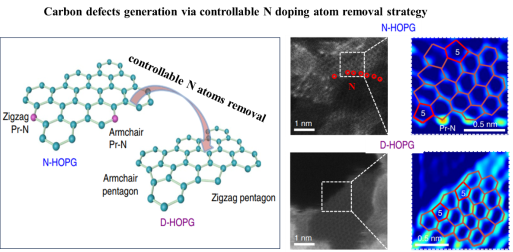
In 2015, we proposed a novel defect electrocatalytic mechanism, identifying defect structures as active centers in carbon-based catalysts, thus pioneering the field of defect electrocatalysis. This theory has since gained widespread acceptance in the research community and has been extended to areas such as thermal catalysis, photocatalysis, CO2 conversion, nitrogen fixation, electrochemical energy storage, hydrogen storage, and analytical chemistry, becoming a cutting-edge and significant domain in electrocatalysis worldwide. We have developed a series of synthetic methodologies for creating defects, including doping atom removal, directed synthesis, voltammetric cycling, 2D material templating, and the defect trapping method.Our research interests range from fundamental mechanism understandings to practical applications of our technology.
- Developing large-scale synthesis methodologies
- Establishingthe theory of defective chemistry
- Exploring practical applications of defective materials
2. Energy catalysis and conversion
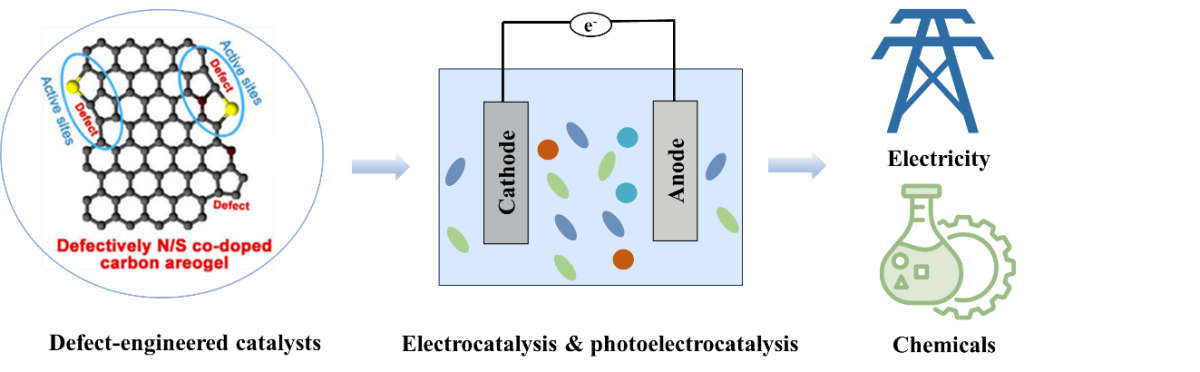
Our research focuses on advancing defect materials for energy conversion technologies, with a primary emphasis on electrocatalytic conversion and photoelectrocatalytic conversion. We aim to precisely engineer and control defect structures within catalytic materials to fundamentally tune their electronic properties, surface reactivity, and charge carrier dynamics. In electrocatalysis, we explore how these tailored defects can serve as highly active and selective sites for critical reactions like water splitting, CO2 reduction, and fuel cell processes. Simultaneously, in photoelectrocatalysis, we investigate the dual role of defects in enhancing light absorption and facilitating the separation and transfer of photogenerated charges, thereby improving the efficiency of solar-driven chemical synthesis. By integrating advanced synthesis, in-situcharacterization, and theoretical modeling, our work seeks to establish definitive structure-property relationships and develop next-generation, defect-engineered catalysts for sustainable and efficient energy conversion systems.
- Developing defect-engineered catalysts for energy conversion systems
- Establishingthe theory between defect structure and catalytic property
- Developing Advanced operando characterizations
3. Energy storage
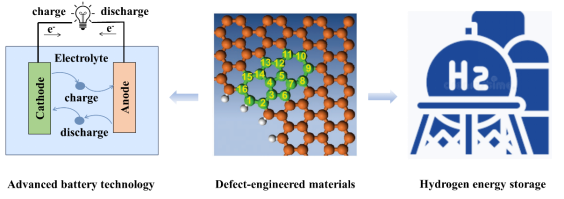
Our research is dedicated to developing next-generation energy storage solutions by strategically integrating defect engineering into advanced materials. We primarily focus on two transformative technologies: battery energy storage and hydrogen energy storage. In the context of batteries, we engineer specific defects to enhance ion diffusion kinetics, improve electronic conductivity, and stabilize electrode structures against degradation. For hydrogen storage, we precisely controlled defect sites to optimize the physisorption and chemisorption of hydrogen, aiming to increase storage capacity, lower operating pressures, and improve (de)hydrogenation kinetics. The ultimate goal is to create high-performance, durable, and economically viable materials to address the critical challenges in energy density, efficiency, and cycle life for both battery and hydrogen storage systems, thereby accelerating the transition to a sustainable energy future.
- Developing defect-engineered materials for battery energy storage and hydrogen energy storage
- Leveraging advanced synthesis, atomic-scale characterization, and computational modeling to establish fundamental design principles.
- Establishing defect engineering as a transformative paradigm for next-generation energy storage technologies.